14 February 2019 – 4.00 p.m. – 14 February 2019 – 6.00 p.m.
Learning is Creating, Creating is being Transformed.
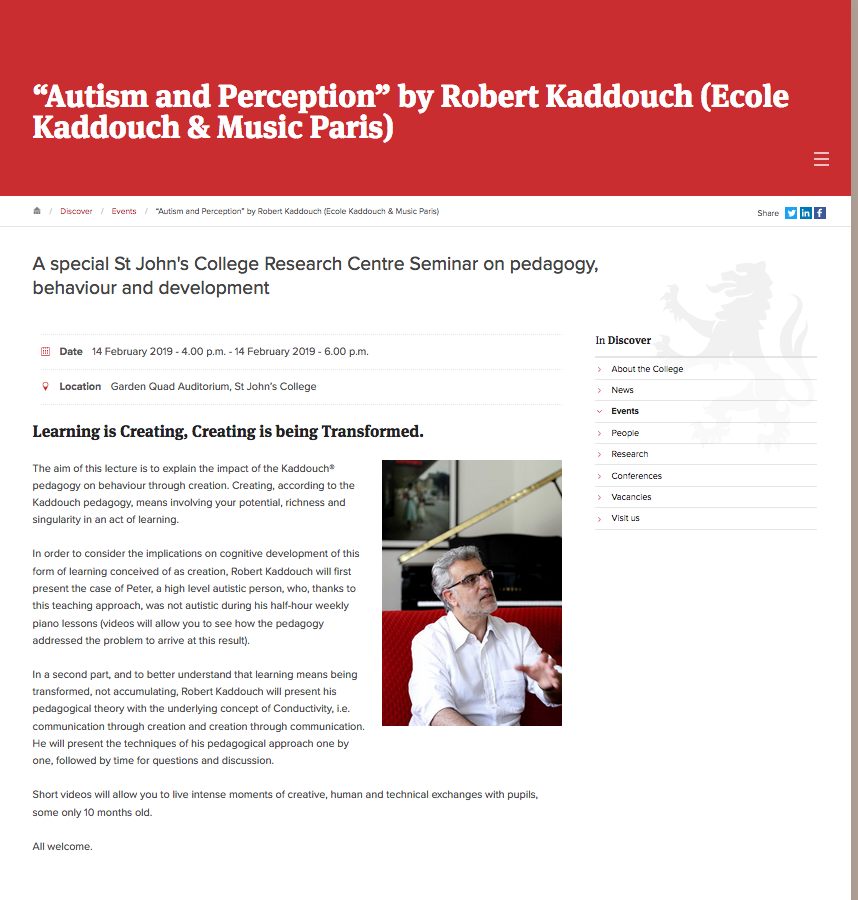
The aim of this seminar is to introduce a pedagogy which claims to have an impact on behaviour through ‘creation’. Creating, according to the Kaddouch pedagogy, means involving your potential, richness and singularity in an act of learning. Robert Kaddouch will present his theory and the underlying concept of ‘conductivity’ i.e. communication through creation and creation through communication.
Kaddouch will illustrate his talk with short videos to allow an insight into exchanges with pupils of all ages and will present a case study of Peter, a person with high-level autism.
There will be an opportunity to discuss his pedagogical approach and time for questions.
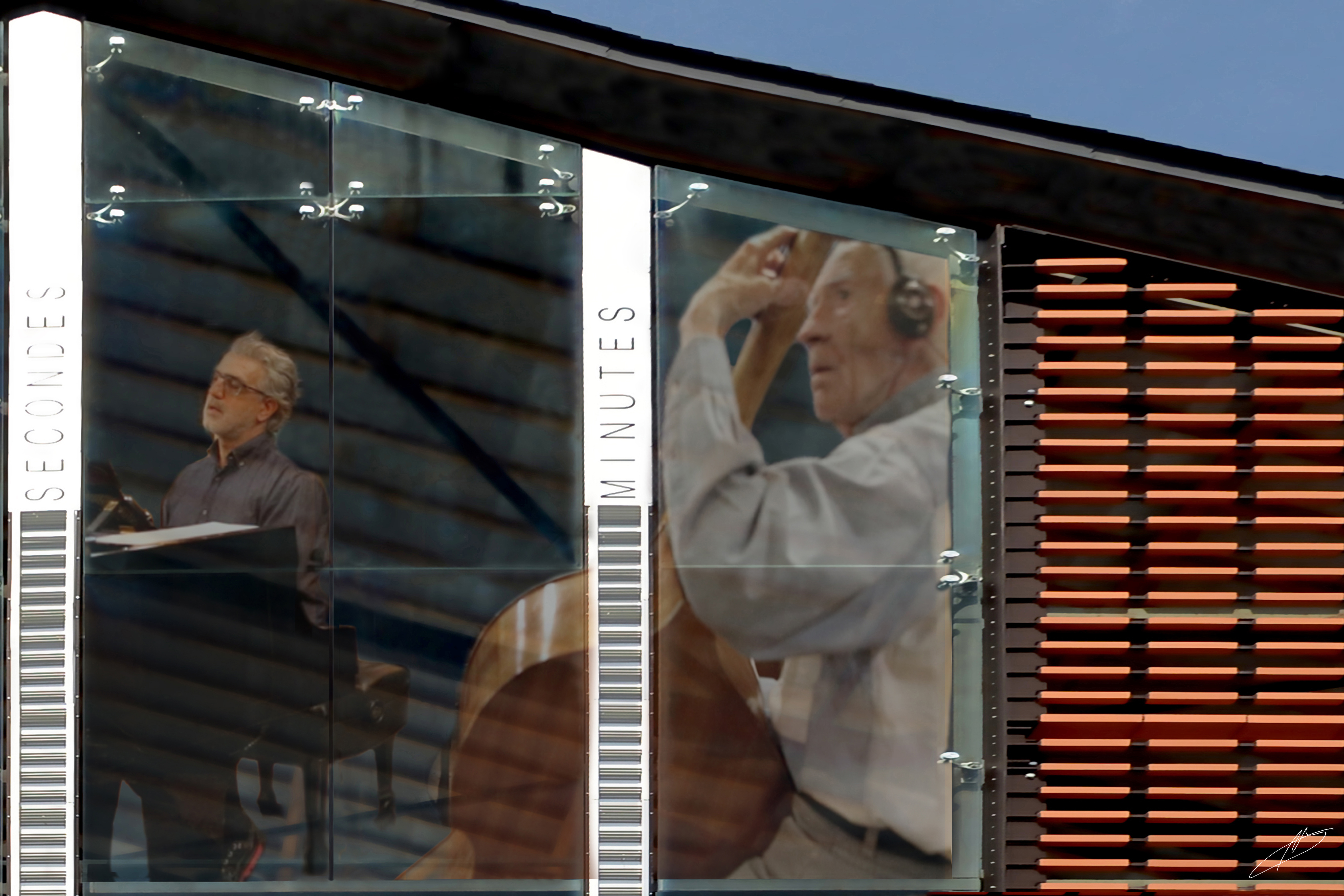
Here is a constellation of compositions that pierces the sky and seems to tell the two musicians that this moment belongs only to them. We can feel in the high notes of French pianist Robert Kaddouch and the deep bass of American Gary Peacock the High Line on which Robert has built its harmonic structure: an unstable equilibrium where musicians, like tightrope walkers, increasingly move away from their comfort zone towards a point where only the fall becomes possible, or a spark of genius climbing even higher towards a new High Line.
At such altitudes, all borders are truly abolished. In New York, July 21 2015, after two days of recording, night falls and the lights quickly illuminate the whole city. The origins of each musical piece and even the songs’ titles have long been forgotten. Is this Besame Mucho or Lover Man? What remains is music, jazz reinventing itself and a constellation of compositions that we follow into an ever deeper blue sky.
Gary Peacock is a jazz legend whose influence has helped redefine the role of the double bass. He has collaborated with some of the greatest jazz artists ever, including Dexter Gordon, Barney Kessel, Bud Shank, Ravi Shankar, Art Pepper Don Ellis, Paul Bley, Archie Shepp, Gil Evans, Tony Wiliams, the Bill Evans Trio, the Albert Ayler Trio, and a stage appearance with Miles Davis, and more recently, 30 years of working with Keith Jarrett and Jack DeJohnette.
Robert Kaddouch has played and recorded with Martial Solal, Daniel Humair and Cesarius Alvim, and as a duo with Jean-François Jenny Clark, Eddie Gomez, Chuck Israels and most recently, Gary Peacock.
Their encounter in July 2015 in New York’s Avatar Studios gave birth to this often bold exploration of traditional themes and standards in their first album, 53rd Street, as well as a freer approach to improvisation developed in High Line.
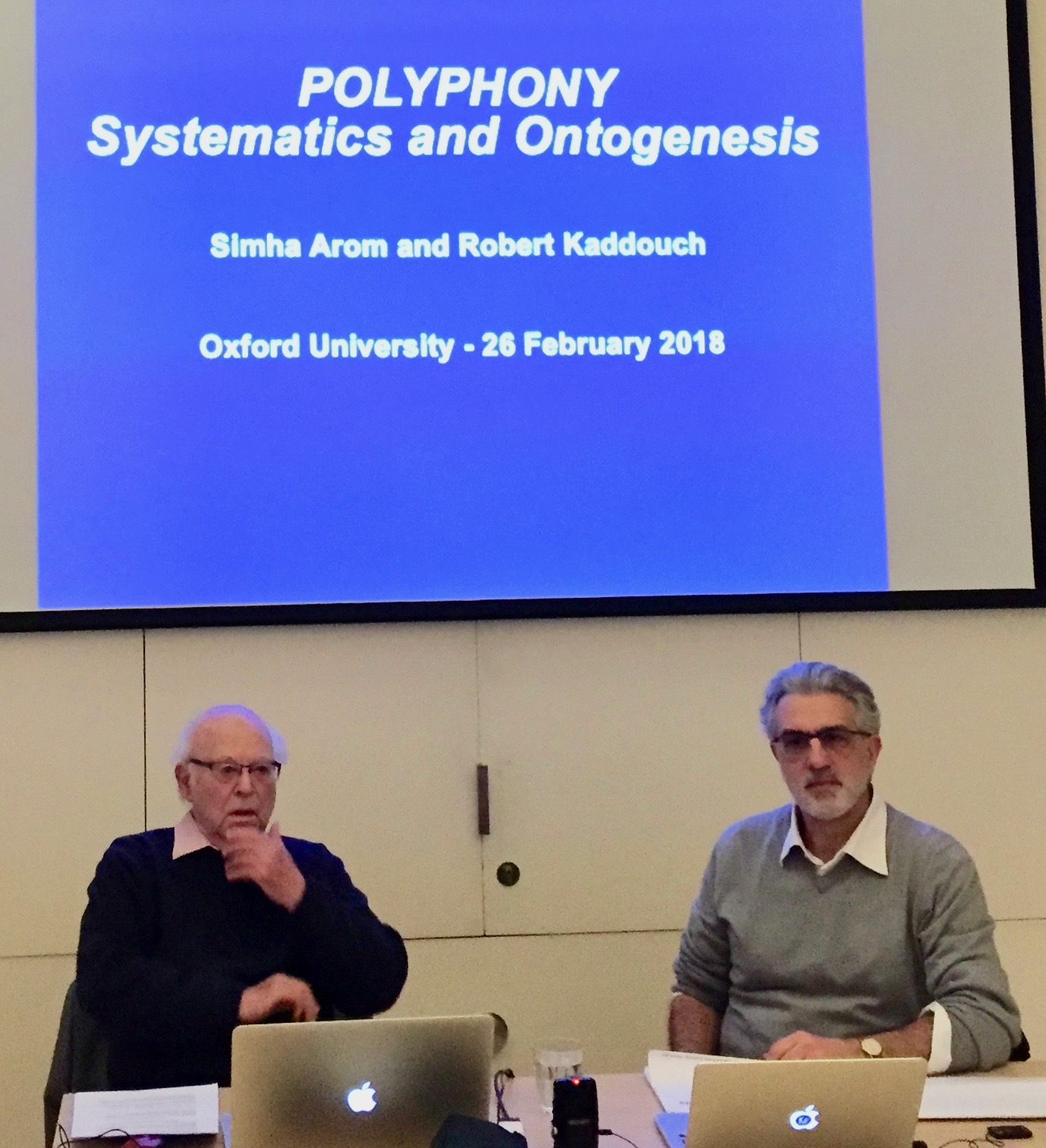
Abstract: To produce a melody is one thing; to couple it with a second one is yet another; but to create unity between several different parts at the same time is a major problem that has called for solutions in different historical epochs and in various cultural contexts. Polyphony – the simultaneous unfolding of several voices – is precisely the art of making different melodic sequences coexist as a whole, which transcends each one of them separately, while preserving its own individuality. It is fascinating to observe how, across places, eras and cultures, people have used similar polyphonic techniques. Through comparative listening, we will identify polyphonic processes common to different musical heritages, chosen independently of epochs and geographical areas. We will discover unsuspected kinships, particularly between the polyphonies of the Pygmies of Central Africa and those composed in Europe in the Middle Ages, as well as between the traditional polyphonies of Georgia and those of the early Renaissance.
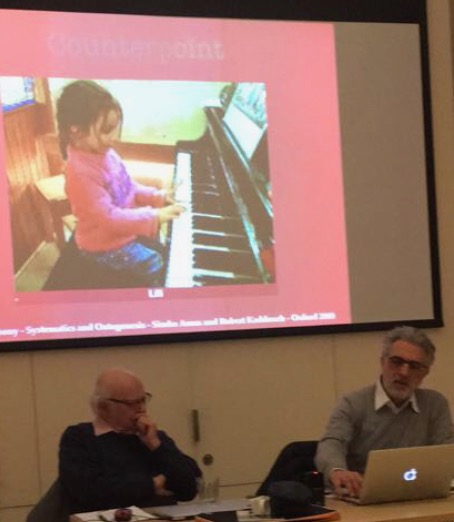
After Simha Arom’s presentation involving comparative listening to various polyphonic processes common to different forms of musical heritage, chosen independently of the time periods, geographical areas and modes of transmission (written or oral), Robert Kaddouch will comment on videos of very young children (between eight months and six years old) in improvisation situations during which they spontaneously draw on some of these processes. The concept of conductibility will shed light on these manifestations.
Présentation de la conférence par le Pr Jason Stanyek et le Pr Reinhard Strohm
Pr Jason Staniek et Pr Reinhard Strohm présentent la conférence
Speaker Biographies: Simha Arom: A French-Israeli ethnomusicologist who is recognized as a world expert on the music of central Africa, especially that of the Central African Republic. His books include African Polyphony and Polyrhythm: Musical Structure and Methodology (1991). In the 1960s, Simha Arom was sent by the Government of Israel to establish a brass band in the Central African Republic. He became fascinated by the traditional music of this country, especially the vocal polyphonies of the Aka Pygmies. He did field work every year from 1971 to 1991, accompanied by ethnolinguists and students, to record this music to study it and preserve it. Simha Arom was awarded a First Prize for French Horn at the Conservatoire National Supérieur de Musique of Paris before becoming an ethnomusicologist. Further research interests: Ethnomusicological methodology, the liturgical music traditions of Ethiopian Jews and the musical heritage of the Jews of Djerba. Arom has been a Visiting Professor at many universities around the world. He is also a member of the Société française de musicologie and the Board of directors of The Universe of Music project (UNESCO). His sound archives were deposited in 2011 at the sound library of the Bibliothèque nationale de France.
Robert Kaddouch is a pianist and a pedagogue. He is the creator of the “Kaddouch Pedagogy” based on the concept of “Conductivity” (The Pedagogue and the Philosopher, Robert Kaddouch and Conductibility, Paris: Harmattan.) He was a student of Pierre Sancan and Bruno Rigutto for the piano, of Iannis Xenakis for composition and of Martial Solal for improvisation; as a pianist he played and recorded with Martial Solal ,Chuck Israels, Gary Peacock , Eddie Gomez …He has been giving courses to teachers and instructors in different disciplines at multiple schools in different countries, and he has collaborated with various research teams (Paris Descartes, Sorbonne, Neurospin, ENS Nicot Institute). He has published several practical and theoretical works, including: Kaddouch, R. & Noulhiane, M., The Child, Music and Memory, De Boeck, 2013; Des Mimes et des Murs, Gruppen, 2012.
Réflexions philosophiques contemporaines autour de la pédagogie innovante de Robert Kaddouch
Dans quelle mesure la pédagogie de Robert Kaddouch interpelle-t-elle la philosophie française contemporaine ? Ce recueil résulte d’une rencontre inédite entre un pédagogue reconnu internationalement dans le domaine de la musique, de l’éducation et de la pédagogie de la création et des philosophes « de métier ». La philosophie française pourrait bien avoir trouvé dans l’?uvre de Robert Kaddouch son pendant pédagogique. Que nous apprend un tel rapprochement, d’une part sur la pensée de Robert Kaddouch, mais aussi sur celles de ces penseurs français ? Quelles perspectives ce rapprochement ouvre-t-il ?
La pédagogie de Robert Kaddouch ne concerne pas uniquement les enseignants, les parents, les musiciens. De fait, elle est aujourd’hui un foyer de réflexion pour la pensée française. Cet ouvrage présente une suite de dialogues entre des philosophes et la pédagogie de Robert Kaddouch. C’est sans doute la première fois que nous assistons à une telle rencontre entre un pédagogue et des philosophes. Les contributeurs exposent, discutent et mettent en perspective les théories de Robert Kaddouch. Notons qu’ils sont tous des spécialistes des auteurs qu’ils commentent. Nous découvrons ainsi des aspects méconnus de la pensée de Simondon, de Bergson, de Lévinas, de Maine De Biran, etc.
Qu’est-ce que créer ? Qu’est-ce que communiquer ? A ces questions, Robert Kaddouch apporte des réponses particulièrement claires et concrètes. Nous en apprenons non seulement sur Robert Kaddouch, mais aussi sur d’autres auteurs et sur des problématiques contemporaines fondamentales en matière de philosophie sociale, de philosophie de l’éducation, de philosophie de la création, de philosophie de la connaissance, etc. Relier la pédagogie de Robert Kaddouch aux idées directrices de grandes figures de la philosophie contemporaine, se révèle au final tout aussi instructif que passionnant.
Robert Kaddouch et la philosophie française
Par Pierre Montebello
Pierre Montebello est Agrégé de philosophie et Professeur de philosophie moderne et contemporaine à l’Université Toulouse-II. Il enseigne auprès d’un large public en France et à l’étranger et intervient dans de multiples conférences à travers le monde. Il est l’auteur de nombreux ouvrages de référence dont certains sont aujourd’hui épuisés.
Pour une métathéorie de la conductibilité
Par Jean-Hugues Barthélémy
Jean-Hugues Barthélémy est le Directeur des Cahiers Simondon et du Centre International Des Études Simondiennes (Fondation « Pour la science »). Il est l’auteur de multiples ouvrages de référence sur Simondon. Il a notamment collaboré avec Bernard Stiegler à la traduction américaine d’ouvrages de Simondon.
La conductibilité, un concept bergsonien ? Création et communication
Par Arnaud François
Arnaud François est Agrégé de philosophie, Maître de Conférence à l’Université Toulouse-II et Directeur adjoint du département de philosophie. Il est chercheur associé du Centre International d’Etude de la Philosophie Française Contemporaine et du Centre International de Recherches en PHilosophie, LEttres, Savoirs (ENS).
Comment exister en tant que quelqu’un ? Le rôle du pédagogue chez Robert Kaddouch
Par Flora Bastiani
Flora Bastiani est Docteur en philosophie et chercheuse associée à l’Équipe de Recherche sur les Rationalités Philosophiques (ERRAPHIS). Elle enseigne à l’Université Toulouse-II. Elle est membre du conseil d’administration de la Société Internationale de Recherche Emmanuel Levinas (SIREL), du Réseau international de recherche sur la santé et la maladie. Elle a obtenu en 2009 le Prix Georges Bastide de l’Académie des Sciences, Inscriptions et Belles Lettres de Toulouse. Elle est directrice du séminaire Maldiney et dirige depuis plusieurs années d’importantes manifestations scientifiques internationales.
Bergson, Kaddouch : comment concilier le Beau, le Bien et le Vrai en éducation ?
Par Sébastien Miravète Sébastien Miravète est Docteur en philosophie, chercheur associé au laboratoire ERRAPHIS, Directeur de séminaire à l’Université Toulouse-II, membre de la Société des Amis de Bergson. Il enseigne au département de Philosophie et au département de Psychologie de l’Université Toulouse-II.